AI Adoption Changes What People Do at Every Company
AI adoption is changing what people do at work. The change hits different companies differently. It hits different people within the same company differently. With the digital transformation efforts of the pre-AI era, people have captured range of emotions employees felt in companies of various sizes.
Neeley and Leonardi captured as a 2x2 in their HBR article for digital transformation back in 2022. I have adopted the same matrix for AI. Two axes: does the employee believe it matters, and does the employee believe they can learn it.
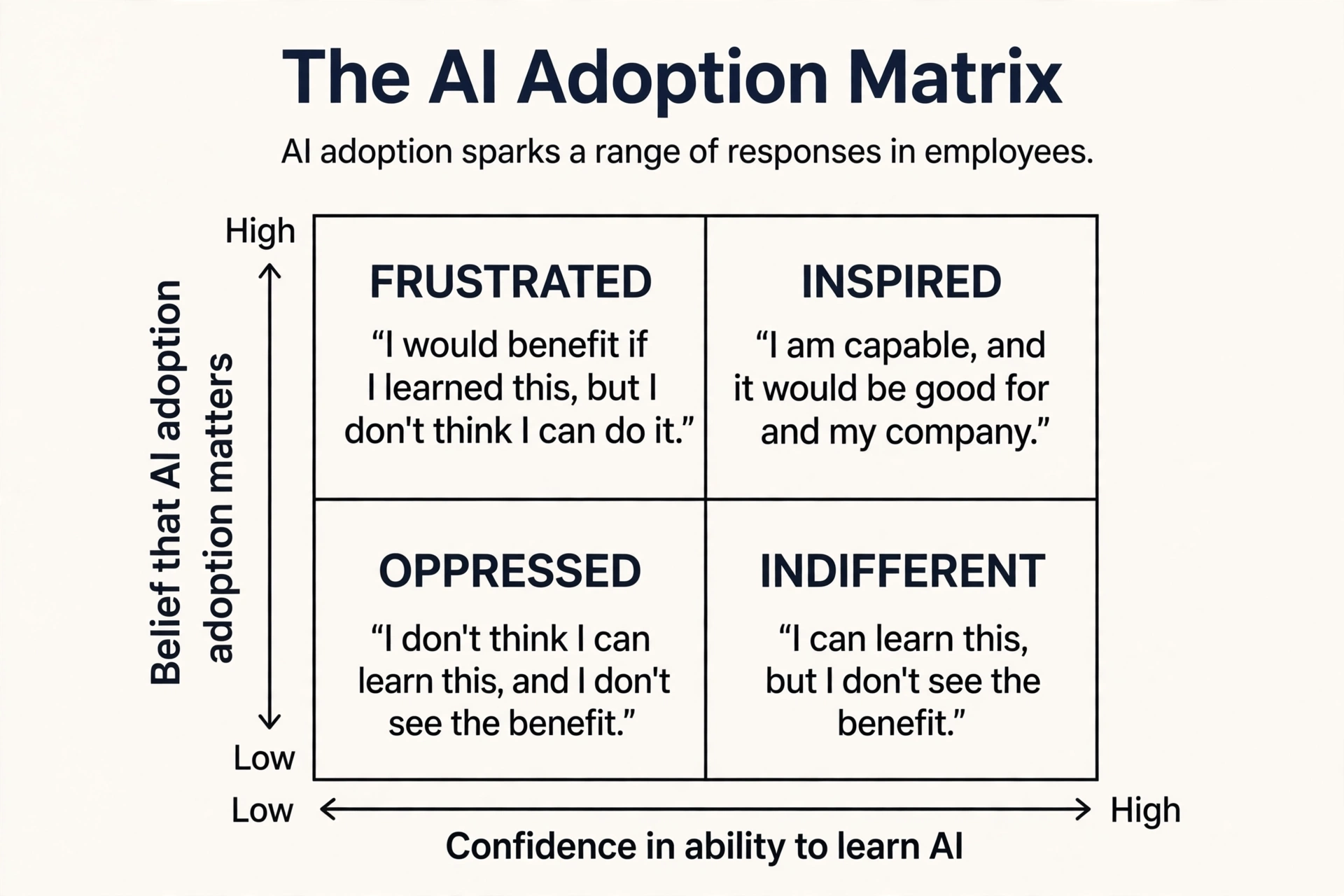
(this 2x2 is my interpretation and is created using AI)
The four quadrants tell the story.
- Inspired: believe AI matters and they can learn it. They say: I am capable, and it would be good for me and my company.
- Frustrated: believe AI matters but cannot learn it. They say: I would benefit if I learned this, but I do not think I can do it.
- Indifferent: believe they can learn AI but do not see the benefit. They say: I can learn this, but I do not see the benefit.
- Oppressed: believe neither. They say: I do not think I can learn this, and I do not see the benefit.
Each quadrant needs a different intervention. The Inspired are your champions. Let them teach. The Frustrated need confidence. Give them sandboxes, coaching, and small wins. The Indifferent need to know why it matters for them personally, not from a company slide deck. The Oppressed need the why first, then low-stakes experience. Mandates alone deepen resistance.
I think it is a good way to represent in a matrix form where someone stands. It does not tell you where they need to go. That is where Molly Graham comes in.
Molly Graham worked at Google and Meta. Her rule was simple: as the company grows, your job changes, so give away your legos. Hand off the work you love to someone else. Pick up the bigger work only you can do now. The deal was good for everyone. The person who got your lego grew. You grew. The pile got better. Change felt like a promotion because it was one. The lego went to a person, and people grow.
I think that AI is rewriting this deal. Hand a lego to a model and nobody grows. The accountability stays exactly where it was: with you. You stop rowing and start steering. You review, correct, and own output you did not make. Treat the model as a replacement and you do not get leverage. You get slop. Low-quality work –> more oversight work.
In the earlier part of the year, there were many posts about grief that people were feeling. The grief people feel about this change is not laziness. It is not technophobia. It is the loss of the craft itself. The flow state of doing the work well is disappearing. Gergely Orosz wrote in his famous blog, Pragmatic Engineer, about this grief when AI writes most of the code — the sadness of watching your craft get automated away. Reinvention means your value moves from doing to judgment. Taste. Vision. The call on what good looks like. Those are the legos you never give away. With AI, people should be informed about the job and allow them to adopt to the new job.
This is why rollouts that only announce the handoff fail. They answer what do I give away. They never answer what do I become once it is gone. Addressing and working within each quadrant needs deliberate choices for the company and and the actions for the people involved.
The Frustrated do not just need confidence with the tool. They need new legos to pick up. The judgment work. So the handoff feels like a trade up, not a loss.
The Indifferent do not need more training. They need to see that steering is a craft, not a demotion. The call on quality is the job now.
The Oppressed need the why first. Then a low-stakes taste of the new job itself. Not the old job with a chatbot attached. Mandates will only deepen resistance.
The Inspired are already reinventing. Give them the visibility, and let them teach. Sharing stories is how the others gain confidence.
MIT’s State of AI in Business 2025 found 95 percent of enterprise GenAI pilots fail to deliver measurable return. Not because of model quality. Because of brittle workflows and misalignment with how people actually work. In the ones that worked, the model was rarely the deciding factor. Organizational readiness & adoption was.
We are all still learning how to adopt to this new way of working. There is more to explore for companies of different sizes — small, mid-sized, and large. The path forward is not settled yet. It is yet to be determined what works and what does not.
References:
-
Neeley and Leonardi, “Developing a Digital Mindset,” Harvard Business Review https://hbr.org/2022/05/developing-a-digital-mindset
-
MIT, “State of AI in Business 2025” https://mlq.ai/media/quarterly_decks/v0.1_State_of_AI_in_Business_2025_Report.pdf
-
Molly Graham, “Give Away Your Legos and Other Commandments for Scaling Startups,” First Round Review https://firstround.com/review/give-away-your-legos-and-other-commandments-for-scaling-startups/
-
Molly Graham on Lenny’s Podcast, “The grief, loneliness, and burnout sweeping through the tech industry right now” https://www.lennyspodcast.com/p/molly-graham
-
Gergely Orosz, “The Grief When AI Writes Most of the Code,” The Pragmatic Engineer https://blog.pragmaticengineer.com/the-grief-when-ai-writes-most-of-the-code/
This blog post was created with the help of AI.